The “Poverty Row Picture Show” is an ongoing series exploring the horror films of Monogram Pictures, Republic Pictures, and PRC, known as the “poverty row” movie studios of Hollywood’s Studio Era. Poverty Row movies were marked by limited budgets, outlandish concepts, and questionable performances. While not great, there remains an everlasting charm with enough star wattage – Boris Karloff, Bela Lugosi, John Carradine, and others – to keep you coming back. As they say, to be in a Poverty Row picture, your career was either moving up or going down!
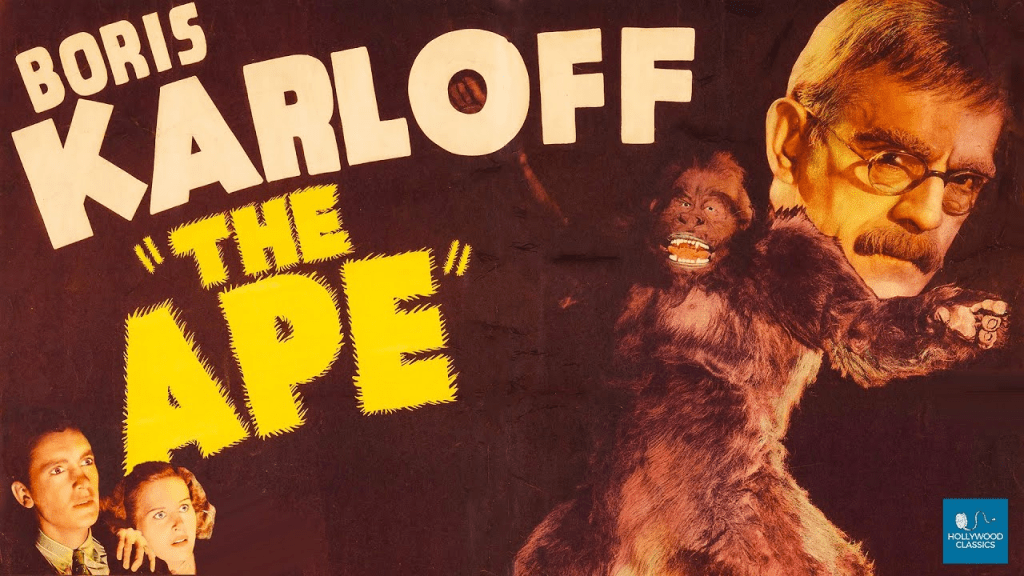
The Ape is Boris Karloff’s foray into Poverty Row horrors, with Monogram Pictures doing its best to harness the actor’s horror reputation. Unsurprisingly, the movie itself is unworthy of Karloff’s talents; however, there is enough overall goofy charm (in part from Karloff’s committed performance) to make The Ape worth your while.
Director: William Nigh
Screenplay: Curt Siodmak, Richard Carroll
Producers: William T. Lackey
Cinematography: Harry Nuemann
Editing: Russell F. Schoengarth
Music: Edward J. Kay (composer)
Select Cast: Boris Karloff, Maris Wrixon, Gene O’Donnell, Dorothy Vaughan, Henry Hall, Roy Corrigan
Runtime: 62 minutes
Country of Origin: USA
Release: September 30, 1940. Monogram Pictures
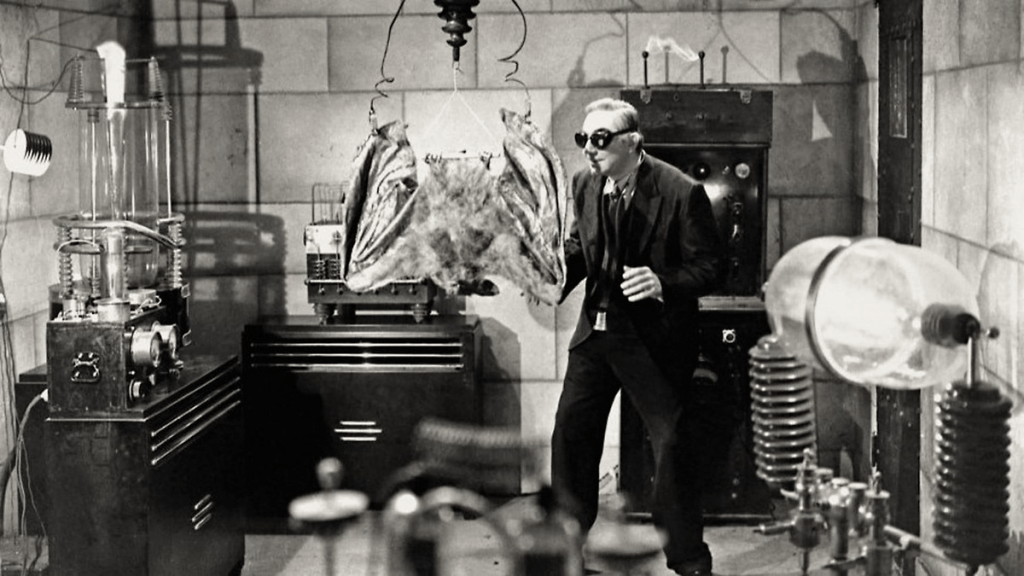
The story is relatively uncomplicated. Secluded in the small country town of Red Creek, lives Dr. Adrian (Karloff), who endeavors to find a cure for paralysis. He lives to experiment, but at the detriment of his reputation in the community. Led by the sheriff and a mean-spirited businessman, a small gang of townsfolk conspire to run Dr. Adrian out of town. They are suspicious of the doctor’s reclusive nature and apparent uninterest in serving the residents. There is one, however, whom Dr. Adrian cares for and it is Frances Clifford (Wrixon); she is a young woman whose legs are paralyzed (we assume polio, but that is never confirmed). Dr. Adrian shares with Frances that she reminds him of his own daughter who, along with his wife, died years before from a “disease”. Thus, Dr. Adrian is determined to cure Frances at any cost.
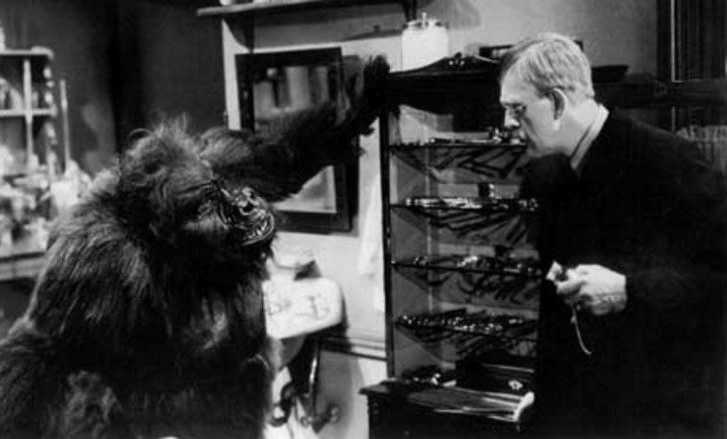
Meanwhile, the circus as arrived in Red Creek and Dr. Adrian urges Frances and her beau, Danny (O’Donnell), to attend. The whole town is there enjoying the show when backstage we are introduced to the ape – a feisty gorilla named Nabu (Corrigan). Nabu is in its cage, being tormented by its keeper, when the inevitable happens: the keeper gets too close to the cage, Nabu wrings him like a wet sock, and a tossed cigarette ignites some straw. The big top burns down as the audience flees and Nabu escapes into the village, finding Dr. Adrian alone in his laboratory. There is a standoff before Dr. Adrian hurls a chemical into Nabu’s eyes and subdues the beast; the doctor hides the gorilla as the animal keeper is brought to Dr. Adrian’s who, unable to save the man, decides to remove his spinal fluid for the sake of the elusive paralysis cure. The spinal fluid indeed proves helpful in restoring Frances’s movement; this seals the deal and as Nabu runs amok killing townspeople, Dr. Adrian uses the newfound spinal fluid to help Frances.
This bizarre crime spree culminates with the authorities gunning down Nabu on the steps of Dr. Adrian’s home. What happens next is quite the twist, so be warned! Frances, in her wheelchair, arrives just in time to see the sheriff reveal the gorilla to actually be Dr. Adrian in disguise! As the doctor dies, he marvels at the sight of Frances stepping out of the chair and walking towards him.
The best part about The Ape is Boris Karloff’s subdued, yet sincere performance. Even in an otherwise forgettable movie, Karloff lends his undeniable screen presence as a mad scientist who never flies off the handle. Perhaps the overall film could have been punched up with a more eccentric doctor (e.g. Rotwang in Metropolis, Dr. Pretorius in Bride of Frankenstein, or any of Bela Lugosi’s Poverty Row doctors), but that decision ultimately rests with the director; left to his own interpretation, Karloff excels. The only other actor worth noting is Ray Corrigan as the gorilla, Nabu. Corrigan made a name for himself playing apes in a multitude of similar films and jungle pictures; in fact, such ape movies were an entire subgenre of horror after the success of King Kong (1933) until waning in the early 1950s. If the movie featured a man-in-a-gorilla, you could bet it was Corrigan in his homemade costume! In The Ape, Corrigan lends an air of camp to the by-the-numbers story.
That story is based on a stage play of the same name by Adam Hull Shirk; the screenplay is by Richard Carroll and Curt Siodmak (credited as “Kurt”). Along with Karloff, Siodmak’s hire was Monogram swinging big with its budget. After the 1938 rerelease of Universal’s Frankenstein and Dracula, horror regained its popularity with cinemagoers; now Monogram had two A-list talents to bring respectability to the studio – Karloff who had recently finished Son of Frankenstein (1939) and Siodmak who was beginning to make a splash in the genre with The Invisible Man Returns (1940). However, almost true to form, Monogram stumbled early in its production. Siodmak was hired with a week before shooting and delivered material more expensive than the studio could manage; Carroll was brought on board to rework (simplify) the script.
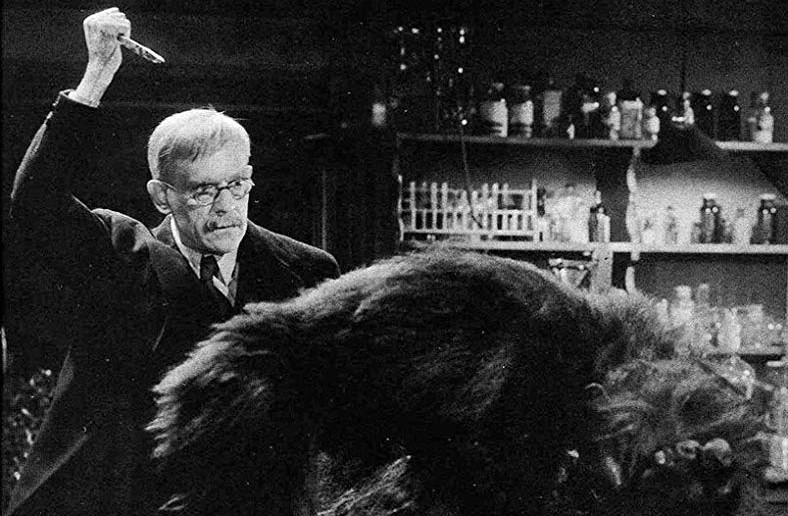
The finished product reflects this expedited process. While serviceable, the script leaves much to be desired; chiefly, the depiction of Dr. Adrian’s experiments! Frances’s operations are left off-screen, and that kind of drama is sorely missed. Absent too, is a deeper backstory for Dr. Adrian that would convey sympathy despite his actions; as portrayed, his motivations are surface-level. As for Nabu, there lacks tension in the monster’s killings; each death is telegraphed long before it happens. Whatever the flaws, however, somehow they do add up to a certain “so-bad-its-good” quality. Maybe it’s because of the actors’ commitment in the face of lines desperately needing rewrites. Take this clumsy exchange between Dr. Adrian and the doomed animal keeper:
Ape Trainer: I don’t feel nothing. Am I going to die?
Dr. Adrian: We all have to die sometime.
Ape Trainer: Just don’t let me die, Doc.
Look, the story is solid and the premise is entertaining; the screenplay just needed more revisions to iron out the wrinkles. For what it is worth, in the following years, Siodmak would turn out true classics like The Wolf Man (1941), the novel Donovan’s Brain (1942), and I Walked With a Zombie (1943). They can’t all be winners! But compared to its Poverty Row contemporaries, The Ape is plenty entertaining. Its legacy, in fact, is quite positive; it was even included in “Boris Karloff: 10 essential films” from the British Film Institute.
This can’t be said for other films of its ilk, but there is plenty of hokum to come on the Poverty Row Picture Show. Next time we will feature The Devil Bat (1940), about another mad scientist who sics giant bats on those who have wronged him. This absurd sounding picture stars Bela Lugosi and it promises to deliver the camp.
Don’t miss the next review – enter your email here!
And follow CAMP KAIJU wherever you podcast!
REFERENCES
Pratt, Vic. “Boris Karloff: 10 essential films”. British Film Institute. https://www.bfi.org.uk/lists/boris-karloff-10-essential-films. Accessed 17 January 2025.
Weaver, Tom. Poverty Row Horrors! Monogram, PRC and Republic Horror Films of the Forties. McFarland & Company, Inc., Publishers. 1993.
 Camp Kaiju