

Godzilla vs. Mechagodzilla is a camp classic. It never holds back in the bizarre elements it throws at you and proves itself to be the highlight of 1970s Godzilla pictures. This is a bold statement considering Jun Fukuda’s reputation; he returns as director for his fifth and final Godzilla film. To be clear, Fukuda’s efforts in the series are not bad. However, compared to the more introspective character-driven dramas of Ishiro Honda, a Fukuda picture is more action-oriented, for better or worse. Arguably, some of the more dubious entries feature Fukuda as director: Ebirah, Horror of the Deep; Son of Godzilla; Godzilla vs. Gigan; and Godzilla vs. Megalon.
Director: Jun Fukuda
Screenplay: Jun Fukuda, Hiroyasu Yamamura
Producers: Tomoyuki Tanaka
Cinematography: Yuzuru Aizawa
Editing: Michiko Ikeda
Music: Masaru Satō
Select Cast: Masaaki Daimon, Kazuya Aoyama, Reiko Tajima, Akihiko Hirata, Hiroshi Koizumi, Masao Imafuku
Runtime: 84 minutes
Country of Origin: Japan
Japanese Release: March 21, 1974; U.S. limited release, 1977, as Godzilla vs. the Bionic Monster
What separates Godzilla vs. Mechagodzilla from the rest of the pack is a sense of controlled chaos. The screenplay by Fukuda and Hiroyasu Yamamura tells the story about a noted scientist, Hideto Miyajima (Hirata) who is kidnapped by villainous space invaders from the Third Planet of the Black Hole. These aliens (who are revealed to be “space apes”) have grand designs on conquering Earth but need two things: a mystic statuette of the kaiju-god protector, King Caesar, and Miyajima’s expertise to finish their byonic “mechagodzilla”. This robo kaiju is the means to defeat Earth’s mightiest monster, Godzilla; as for the statuette, it serves as the MacGuffin central to a plot involving space-ape-gangsters and INTERPOL agents.
It is a wild story that benefits from Fukuda’s renegade direction and gritty cinematography by Yuzuru Aizawa (a Kurosawa collaborator on the crime film The Bad Sleep Well). Fukuda himself was well-versed in crime capers, having made his name in the genre in the 1960s. Perhaps it is Fukuda and Aizawa’s knack for crime flicks that gives Godzilla vs. Mechagodzilla a lasting visual style; more often that not, the camera is handheld which lends a visceral edge to the many tussles and shootouts among the human characters. But the same is true for the monster fights. The finale between Godzilla, King Caesar, and Mechagodzilla is a tapestry of explosions and creative fight choreography. Then, the one-on-one match ups between Godzilla and Mechagodzilla (as well as Mechagodzilla and Anguirus!) are equally memorable with a grounded brutality; the creators lean into this tone with blood effects and dark, foreboding atmospheres.

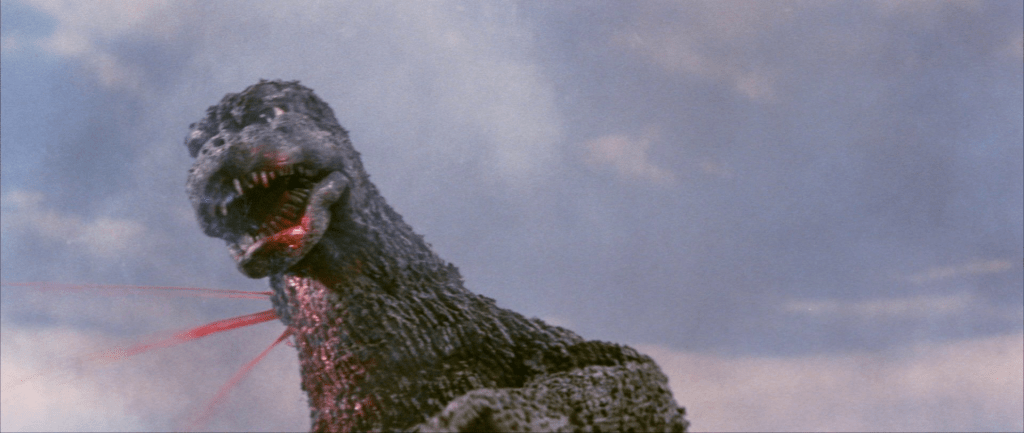

The cumulative effect of these talents are so graphic that they weirdly run counter to where Godzilla vs. Mechagodzilla falls within the grander Godzilla timeline. By 1974, Godzilla movies had become childrens’ fare; the preceding Godzilla vs. Megalon is a prime example, with a child protagonist and family-friendly vibes. This example is to illustrate that audiences had come to expect a certain tone from Godzilla movies. Physically reflecting this is the suit design for Godzilla in Godzilla vs. Mechagodzilla, which remains the same from Megalon; the face sports rounded features like big eyes and a short, friendly muzzle. All to indicate a cartoonish warmth. However, this design feels disjointed with the overall “adult” aesthetics of Mechagodzilla. This criticism may not be apparent to those unfamiliar with the trajectory of Godzilla productions at Toho; nevertheless, there is a sense that Fukuda and Aizawa’s mature efforts are hampered by the studio’s G-rated expectations.
This contrast, however, is exactly what makes Godzilla vs. Mechagodzilla a camp classic. This is a movie that simultaneously delivers ostensible kid-friendly space apes chewing cigars and roasting people alive; with ostensible kid-friendly kaiju bleeding out after vicious attacks. Then, as if to top their own mania, Fukuda and company underscore it all with bombastic jazzy beats and throw inexplicable plot twists into the fray. There is no reason why Godzilla should turn into a magnet. And yet, it works thanks to the incredulous world that Fukuda has grounded in reality. Godzilla vs. Mechagodzilla works because it is committed to being so boldly far-fetched; it is an audacious effort that allows the film to stand the test of time. It may not be among the best Godzilla movies of all time, but it is arguably the best Godzilla movie from an era when so much was so uninspired.
by Vincent S. Hannam
Don’t miss the next review – enter your email here!
And follow CAMP KAIJU wherever you podcast!

 Camp Kaiju
One thought on “Godzilla vs. Mechagodzilla (1974) Movie Review”