
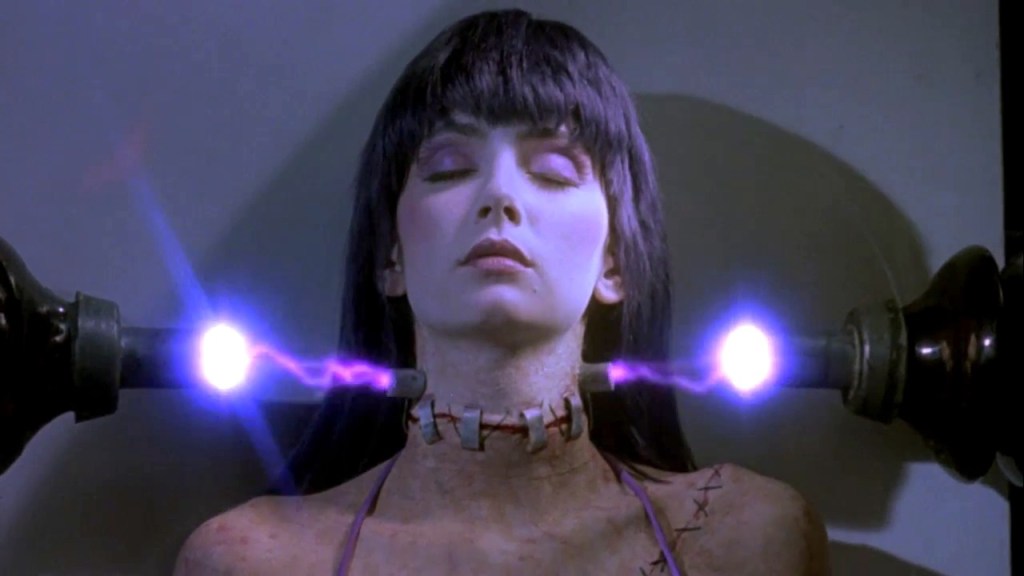
Frankenhooker is not the worst Frankenstein adaptation out there (hello, Jesse James Meets Frankenstein’s Daughter) but it ranks low. This 1990 black comedy comes from exploitation maestro, Frank Henenlotter, the director of Basket Case. Like Basket Case, Frankenhooker is sleazy, crass, and gory; but unlike its predecessor, Frankenhooker lacks inspiration.
Director: Frank Henenlotter
Producer: Edgar Ievins
Writers: Frank Henenlotter, Robert Martin
Cinematographer: Robert M. Baldwin
Editor: Kevin Trent
Music: Joe Renzetti
Select Cast: James Lorinz, Patty Mullen, Joanne Ritchie, Joseph Gonzalez
Runtime: 85 minutes
Country of Origin: USA
US Release: June 1, 1990; Levins-Henenlotter, Shapiro-Glickenhaus Entertainment
The messaging of Basket Case may be suspect but its craftsmanship is undeniable. The same cannot be said for Frankenhooker, which comes off as one big excuse to feature as many disembodied breasts as possible; again, not inherently off-putting, but without the benefits of a heightened visual style (as with say, Andy Warhol’s equally booby Flesh for Frankenstein), the effect is childish and uninteresting.
This insipid aesthetic is strengthened by the lackluster performance of James Lorinz as Jeffrey Franken. Jeffrey seeks to reanimate the corpse of his fiancée (Patty Mullen) who was shredded in a freak lawnmower accident. But where to find replacement body parts? By way of a gang of prostitutes, whom Jeffrey seduces with money and crack; as he says, “you’re like cats to catnip!”
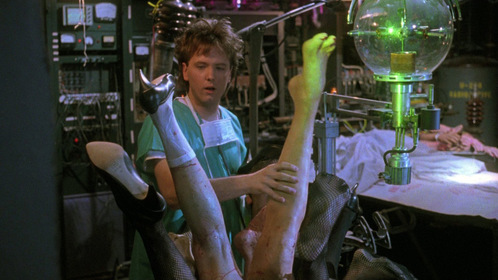
From there it is a series of scenes featuring as many naked women as possible; and yet, there is an unfortunate sense of restraint in the picture. Based on Henenlotter’s self-described love for exploitation, you would expect more of the tasteless content that would at least make the movie memorable (another more worthwhile endeavor is Stuart Gordon’s Re-Animator). Further missing is a gritty sense of danger amongst the junkies, pimps, and street walkers of Times Square. The final product somehow feels too clean for its self-perceived controversial nature.
It’s as if Frankenhooker is caught between the shifting cultural attitudes of the 1980s to ‘90s, when mayor Rudy Giuliani famously “cleaned up” the streets of New York, erasing the seedy nature that defined its ‘80s identity. To use heavy metal music as an example: the ‘80s started with the raw, offensive spirit of the genre but ended in the early ‘90s as an over-refined, sterile, and commercialized parody of itself. Perhaps the same is true for the B-movies of the 1980s.
by Vincent S. Hannam
Don’t miss the next review – enter your email here!
 Camp Kaiju