

Two Lost Worlds is a cult classic worth seeking out. How often do you find a combined pirate and dinosaur movie? At least that’s the self-prescribed hype of the film, and depending on your expectations, you will either be thrilled or underwhelmed by that hype. Nevertheless, there are indeed pirates and dinosaurs to enjoy, along with a charming cast led by James Arness and Kasey Rogers.
Director: Norman Dawn
Screenplay: Boris Petroff, Tom Hubbard, Phyllis Parker
Producers: Boris Petroff
Cinematography: Harry Neumann
Editing: Fred R. Feitshans Jr.
Music: Alex Alexander
Select Cast: James Arness, Kasey Rogers (as Laura Elliot), Gloria Petroff, Bill Kennedy
Runtime: 61 minutes
Country of Origin: USA
US Release: January 5, 1951; Sterling Productions, Inc.
Two Lost Worlds opens with a narrator recounting the proud shipping traditions of 1830s America, before focusing its attention on the clipper ship Hamilton Queen. The ship is setting sail to the South Pacific on a mission for precious cargo. Onboard, leading the venture, is the Queen‘s owner, Kirk Hamilton (Arness). Everything is smooth sailing until they approach Queensland, Australia where they are attacked by pirates. The brigands are repelled, but Hamilton is wounded in the battle. Onshore now, he is left in the care of the local English settlers to recuperate until the Hamilton Queen returns from its voyage to pick him up. Here he meets young ingenue Elaine Jeffries (Rogers) and her precocious kid sister Janice (Petroff). Predictably, Hamilton and Elaine fall in love at the expense of Elaine’s ostensible fiancé Martin (Kennedy). The story grows less predictable when the settlers (alongside the crew of the Hamilton Queen) engage the pirates in a final showdown on the high seas. As both the Queen and the pirate ship sink, Hamilton, Elaine, Janice, Martin, and others escape in a lifeboat only to find themselves stranded on a barren island. Away from the beach, however, they stumble upon a lost world of dinosaurs and one ominously active volcano. Meanwhile, a rescue ship is headed their way; but on the island, the gang must survive the prehistoric monsters and the now erupting volcano. Dodging lava flows and falling rocks, they board the rescue ship and sail home.

For an hour long movie, there is a lot to unpack. First, the blending of genre is unique and handled with aplomb; somehow there is never a sense of tonal difference. Two Lost Worlds is not just an action-adventure, nor is just a science fiction spectacle; the film contains amusing melodrama and even elements of pseudo-documentary. The narrator conceit (voiced by Don Riss) adds to the documentary feel, as does the abundant stock footage of Australian sheep ranching. Credit to the creative team for establishing location so thoroughly in such a short span. The characters are also given plenty of attention; they are all colorful archetypes brought to life by a cast clearly enjoying each other’s company. The casting director is uncredited, but Two Lost Worlds is a great example of what good casting can do: elevate an otherwise run-of-the-mill picture.
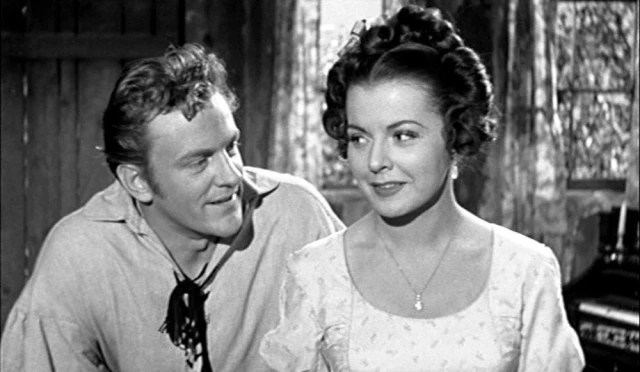
James Arness – here billed as “Jim Aurness” – stars in his first leading role. Arness is best known for playing Marshal Matt Dillon on TV’s Gunsmoke for twenty years. But monster movie fans will know him as the titular Thing in Howard Hawks’ The Thing from Another World (1951), as well as FBI agent Graham in Them! (1954). As Kirk Hamilton, Arness confidently delivers the noble hero persona he would become known for. Playing opposite him is Kasey Rogers (TV’s Bewitched; Strangers on a Train) who brings a delightful charm and grit to her relationships with Hamilton and Martin; she is a clear-eyed woman unafraid to love as she sees fit. Gloria Petroff also stands out as a spunky young girl; she looks like she is having a ball on set.
Despite all the character work, however, Two Lost Worlds is chock-full of action. While much of these sequences are rendered via stock footage, they are no less thrilling. The climactic battle between the Hamilton Queen and the pirate ship is as exciting as you would hope, never mind that it is footage from Captain Caution (1940). The dinosaur footage is also stock, taken from One Million B.C. (1940). Incidentally, One Million B.C. was nominated for Best Special Effects at the 1941 Academy Awards. That recognition, however, has not aged well. The “dinosaurs” involved consist of a baby alligator with a Dimetrodon-like sail glued to its back and an Argentine black and white tegu. In other words, real reptiles were goaded into fighting each other, presumably to the death (the tegu does not look well at the end!). While these set-pieces are shot boldly with the human characters photographed in the foreground, the blatant animal abuse is hard to stomach. Unfortunately, this trope of filming real reptiles as dinosaurs (known as “slurpasaurs”) would be a hallmark of low-grade 1950s b-movies. And ironically, most of these other movies would also pull from the same One Million B.C. footage.

This depiction of dinosaurs is where the hype of Two Lost Worlds might be overblown, along with its pirate storyline. Yes, it is a “pirate-dinosaur” movie, but the reality is more nuanced; it is a pirate movie that inexplicably becomes a dinosaur movie. Again, this drastic shift in genre is handled effectively, but it is worth noting that dinosaurs do not fight pirates. Be that as it may, Two Lost Worlds still delivers much entertainment despite its limitations. And for that, it is easy to recommend.
by Vincent S. Hannam
Don’t miss the next review – subscribe now &
follow CAMP KAIJU wherever you podcast!
 Camp Kaiju