
Madness and obsession is often played for thrills in cinema, especially in the horror genre; many reviews for such films include disclaimers about the inaccuracy of the mental illness depicted. It is not the filmmakers intentionally wishing to misrepresent the very real struggles of individuals, but a movie is often compelled to take liberties with a subject matter for better or for worse. The onscreen depiction of dissociative identity disorder, for example, has a long and complicated history, from Hitchock’s Psycho to M Night Shyamalan’s Split. Nevertheless, however one feels about the need for popular films to make a subject more “interesting”, the real point is that this author is not a medical professional; this author can only comment on the driving obsession that leads a couple of villains to their demise in two horror movies separated by 88 years: Mad Love and Tearsucker.
The more established of those films, Mad Love, was released by MGM in 1935. Directed by Karl Freund, the movie stars Peter Lorre (in his American film debut), Frances Drake, and Colin Clive. Mad Love is a retelling of the story, The Hands of Orlac (Les Mains d’Orlac) by Maurice Renard, an early writer of fictional body horror. The 1920 short story concerns a world-class pianist, Stephen Orlac, who loses his hands in a train wreck, only to have them replaced by the hands of a recently executed murderer. Naturally, the hands still retain the killer’s lust for blood with Orlac powerless to resist. Renard’s story was first filmed in 1924’s Orlacs Hände by the duo behind The Cabinet of Dr. Caligari, director Robert Wiene and actor Conrad Veidt. This rendition adheres closely to the Orlac-centered story; Mad Love, on the other hand, takes a decidedly different approach to the material.
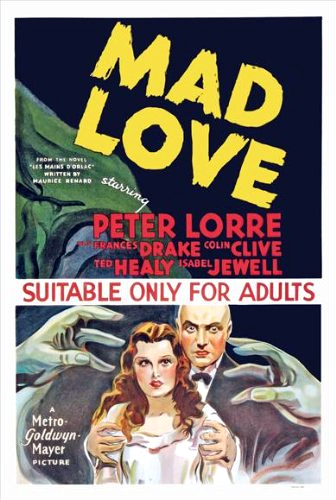
That approach, directed by Karl Freund (1932’s The Mummy), centers more on the surgeon performing the transplant, Dr. Gogol (Lorre); this character is never named in the previous adaptation and therefore, the choice to focus the drama here (rather than Colin Clive’s Orlac) is at first perplexing. Gogol’s conflict, however, is no less interesting. He is a world-renowned surgeon who grows fixated on Orlac’s wife Yvonne (Drake) after witnessing her stage performances at the “Théâtre des Horreurs”, a horror-themed playhouse in Paris. Any aid that Gogol offers Orlac, then, is motivated by a desire to separate him from Yvonne; in this context, the new title Mad Love makes more sense. This is not “The Hands of Orlac” but something new. And while those dastardly hands do wreak havoc, the main drama is concerned with a man’s deadly obsession with one woman.
What makes Mad Love complementary with Tearsucker, is the unique mix of sexual obsession with weird body horror. Tearsucker is a 2023 horror-thriller that premiered at the Chattanooga Film Festival. It is directed by Stephen Vanderpool (SlashFM), with a script by Sam Brittan. Brittan also plays Tom, a man who displays a fetish for “sucking” women’s tears; but soon this behavior is revealed as murderous obsession after the man grows fixated on Lilly (Allison Walter), an emotionally-distressed woman prone to sobbing. As with Lorre’s Gogol, the film presents Tom as a seemingly charming man; and in both movies the women ultimately push aside any mistrust in the interest of civility or in Lilly’s case, romance. Despite this difference, both films nevertheless tell stories of women confronting their stalkers; both films also comment on the obsession with unusual body parts.

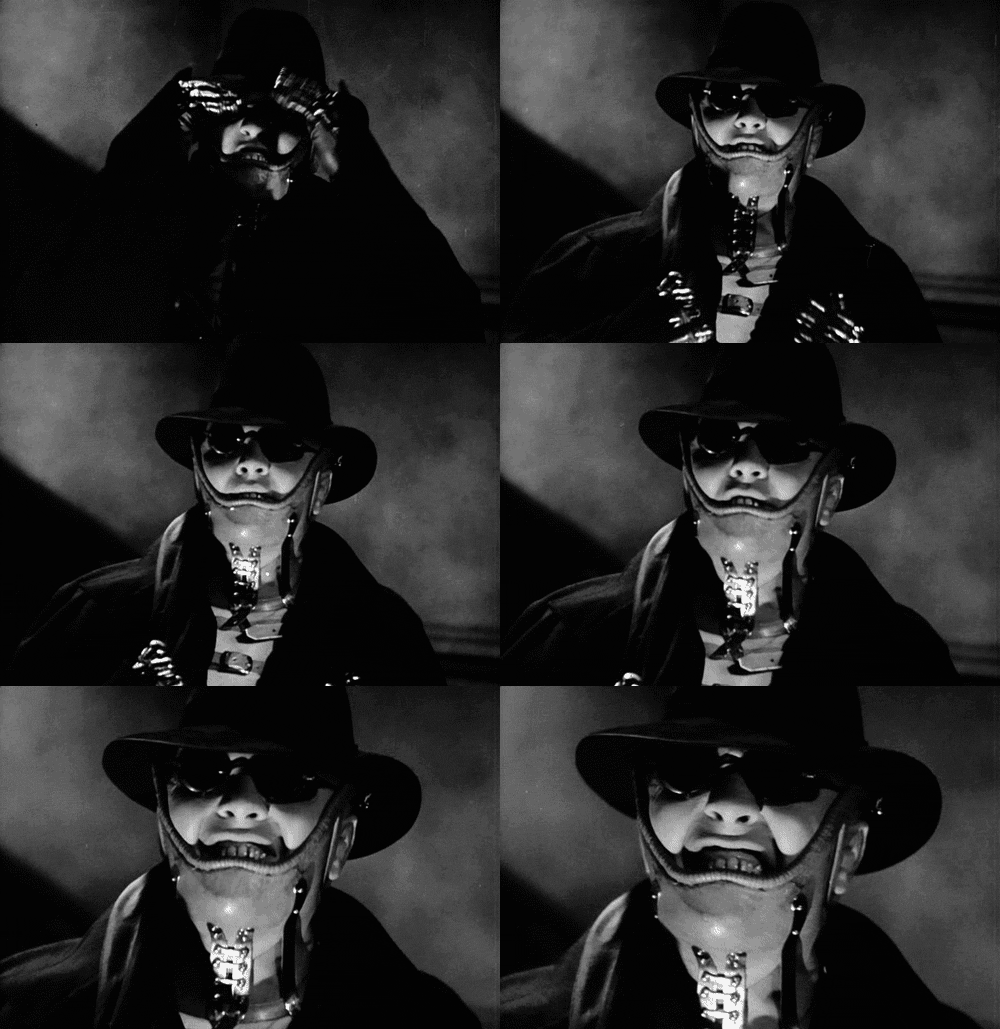
As a transplant surgeon, Gogol knows how to manipulate dead bodies for ulterior motives. In the film’s most well-known scene, Gogol confronts Orlac disguised as the beheaded murderer whose hands were transplanted. Orlac is delirious and believes this murderer is alive with new arms and a head reattached by Gogol. Throughout the movie, Gogol’s obsession with Yvonne is interwoven with this amoral approach to the dead; it is a cold and clinical feeling reminiscent of another mad doctor, Hannibal Lector. Unlike Lector, however, Gogol feels a great deal for his target; yes, to the point of trying to kill her, but in this way, Mad Love is more attuned to the portrayal of obsession in Tearsucker.
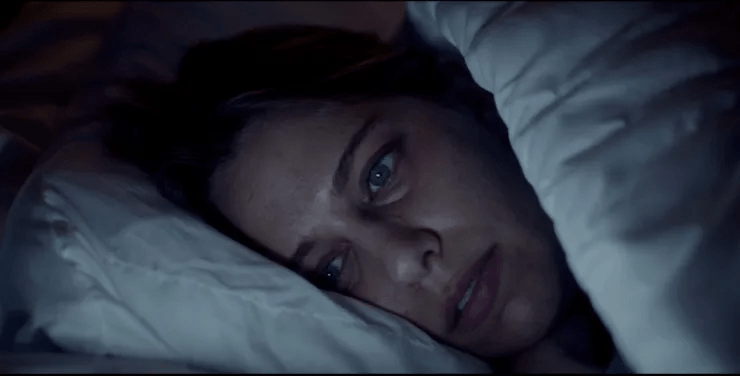
Many reviews of Vanderpool’s film use “psycho” or “psychopath” to describe Tom; and while there is no official medical diagnosis of psychopathy, the term is commonly acknowledged under the official umbrella term antisocial personality disorder (ASPD). Traits related to psychopathy include, ” a lack of guilt and remorse, a callous lack of empathy, a lack of concern about one’s performance on important activities, and a general lack of emotional expression.” These characteristics are certainly displayed in Tom and yet, there is just enough to hint at deeper feelings toward Lilly. Unfortunately, as with Gogol, Tom is incapable of expressing his feelings in a safe and predictable manner. Also like Gogol, an unorthodox relationship with the human body is central to his character. Tom “feeds” on women’s tears; he seduces them and attacks them once the tears flow; and he kills them at the height of sexual pleasure.
Admittedly, Tom’s obsession is more rooted in a contemporary cinematic approach to violent mental illness; depictions of psychology in film itself were only beginning in the 1930s, much less conditions such as psychopathy or sociopathy. Those would come much later in the 20th century. However, the DNA of movies like Mad Love can be observed in a film like Tearsucker. Considering its objectively-absurd premise, Tearsucker would seemingly fit well into the landscape of Pre-Code horror, rife with murder and female obsession; hypothetical images of Lon Chaney or Bela Lugosi playing Tom come to mind with Tod Browning as director. As for Mad Love, perhaps it better belongs in today’s era of filmmaking. Imagine a version unbound by a censorship board, where a director like Stephen Vanderpool can depict Gogol’s obsession in the most stark and frightening ways.
Mad Love and Tearsucker are not the same movie, but when watched together, similar themes emerge: obsession, madness, gross body stuff, and where they all intersect within the toxic male gaze. How these themes are portrayed in 1935 versus 2023 adds another interesting layer from a cultural and storytelling point of view. Ultimately, these two movies, whether watched together or on their own, offer viewers much to chew on.
by Vincent S. Hannam
Mad Love (1935)
Director: Karl Freund
Screenplay: John L. Balderston, P.J. Wolfson
Producers: John W. Considine Jr.
Cinematography: Gregg Toland, Chester A. Lyons
Editor: Hugh Wynn
Music: Dimitri Tiomkin, David Snell, R. H. Bassett
Select Cast: Peter Lorre, Frances Drake, Colin Clive, Edward Brophy, Ted Healy, Sara Haden
Runtime: 68 minutes
Country of Origin: USA
U.S. Release Date: July 12, 1935 – MGM
~
Tearsucker (2023)
Director: Stephen Vanderpool
Screenplay: Sam Brittan
Producers: Sam Brittan, Robert Campbell, Stephen Vanderpool
Cinematography: Stephen Vanderpool
Select Cast: Sam Brittan, Allison Walter, Danielle McRae Spisso, Emily Yetter, Matthew Wayne Roberts, Kelly Love
Runtime: 94 minutes
Country of Origin: USA
U.S. Release Date: July 7, 2023 – Das Produktion Machine, Pig Moon Pictures
 Camp Kaiju
3 thoughts on “Mad Love (1935) & Tearsucker (2023) Movie Reviews | Weird Deadly Obsessions”